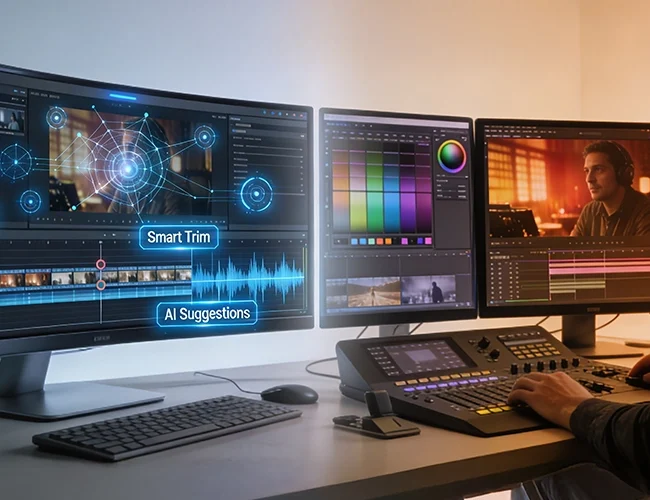
Artificial intelligence is transforming animation production, management, and delivery in various industries. From corporate and advertising video editing to large-scale movie production, studios are experimenting with novel ways of using AI 3D animation to produce faster, smarter, and cheaper results.
For animation and VFX studio decision makers, game industry firms, ad agencies, and production houses, the issue is no longer about whether AI can be used but how it can be used without sacrificing creative integrity.
The Increasing Importance of AI in 3D Animation
AI 3D animation growth is helping studios automate repetitive processes, enhance rendering performance, and improve character modeling. For VFX supervisors and creative directors, AI translates to shorter turnaround times and more bandwidth to work on high-value creative projects.
AI uses include 3D animation, AI video creation, and predictive algorithms that modify lighting, textures, and motion in real time. Studios are testing AI 3D animation generators to create concept models, and some teams use AI art anime 3D tools to create prototypes of characters for games and e-learning modules.
For ad agencies, AI enables the creation of dynamic branded content that varies according to demand in the marketplace. For game companies, AI streamlines asset creation and enables AI 3D animators to create characters, environments, and cutscenes at scale.
Opportunities for Studios Using AI in 3D Animation
Studios today are under constant pressure to deliver more with less. AI opens up opportunities that make animation faster, smarter, and more versatile.
- Speed and Efficiency
AI-assisted animation workflows reduce production bottlenecks. Neural rendering, in particular, is helping studios deliver high-quality output much faster. Using neural rendering to speed up animation is no longer an experimental idea; it is now a practical reality for film, gaming, and advertising projects.
- Cost Optimization
Studios are always under pressure to balance quality with budgets. AI reduces dependency on extensive manual labor for repetitive tasks like rigging and background design. This translates into measurable cost savings for producers and studio heads without compromising deadlines.
- Creative Exploration
Animation’s future depends on combining machine learning skills with human creativity. For example, campaign directors in advertising companies can use AI-driven variations to test different animated ad versions, while game producers can instantly visualize new gameplay characters.
- Expanded Service Offerings
Many production houses are using AI to diversify their portfolios. Whether it’s offering character animation services, machine installation 3D animation services, or collaborating with a 3D video agency, AI tools allow studios to expand into new verticals with confidence.
Challenges Faced by Studios with AI 3D Animation
While AI creates opportunities, it also presents unique challenges that decision makers need to address.
- Skill Gaps : Art directors and animators must adapt to new tools. Knowing traditional workflows is no longer enough; teams must understand AI animation tools and integrate them into pipelines.
- Creative Control : AI-generated animation risks producing generic or repetitive designs. Maintaining originality and brand consistency requires careful oversight.
- Integration with Legacy Systems : Established studios often have legacy rendering setups. Incorporating AI into such environments requires workflow redesign and possible system overhauls.
- Ethical Considerations : From ownership of AI-generated content to authenticity in storytelling, legal and creative concerns remain at the forefront.
AI in Industry-Specific Contexts
Different industries face unique creative and operational challenges. AI in 3D animation adapts to each sector, offering tools that solve practical problems.
- Animation and VFX Studios
AI-driven solutions simplify AI in VFX and film, particularly in intricate post-production processes. Supervisors can concentrate on narrative and creative coherence as scene cleanups, rotoscoping, and effects layering are automated.
- Gaming Companies
Game producers and CTOs are tapping into 3D animation AI for real-time asset generation and adaptive storytelling. AI also helps test visual elements quickly, reducing iteration cycles.
- Advertising and Creative Agencies
Agencies are exploring 3D animation AI video tools to deliver targeted, personalized campaigns at scale. This is especially powerful when combined with sports video production and AI tools for interactive brand experiences.
- Film and TV Production Houses
Producers and post-production managers use AI 3D animators to accelerate timelines. From pre-visualization to final renders, AI ensures faster project delivery and high production values.
- EdTech and eLearning Companies
AI in 3D animation simplifies complex concepts for instructional designers and content directors. Animated learning materials can be built faster, with adaptive character modeling through AI 3D model animators.
Benefits of AI for Animation Studios
The value of AI is not just in cost reduction but in the long-term scalability it offers. Studios can streamline projects while raising quality benchmarks. Some of the benefits include-
- Reduced rendering time with AI-assisted animation workflows.
- Scalability for projects of all sizes.
- Improved collaboration between creative and technical teams.
- Access to cost-effective solutions through outsourcing partners like Video Caddy, a trusted 3D video editing company.
Practical Applications and Deployment Exampes
AI-driven 3D animation is no longer theoretical. Studios worldwide are already using it across multiple formats and client requirements.
- Film Studios : AI-driven rotoscoping for seamless integration of live action with visual effects.
- Gaming : Adaptive AI systems that adjust in-game animations to match player interactions.
- Corporate Videos : Branded explainers and product demonstrations powered by AI 3D animation video technology.
- Education : Interactive storytelling in 3D learning environments.
The Road Ahead
The future of animation will be defined by the intersection of human creativity and machine efficiency, even as AI transforms the field. Manufacturing companies will have to spend money on retraining employees, modernizing machinery, and employing specialists with knowledge of AI-driven processes.
Video Caddy assists animation and VFX studios, game development firms, and ad agencies with AI 3D animation solutions. With service-specific delivery and domain-specific expertise, our professionals enable studios to utilize AI without compromising on artistic requirements and production quality.
FAQ’s
1. How is AI changing the way 3D animation is done in studios?
AI helps studios achieve deadlines more quickly and with fewer bottlenecks by streamlining repetitive operations, speeding up rendering, and broadening creative horizons.
2. Are animators in the movie and video game industries being replaced by AI?
No, AI assists animators with technical work while letting humans handle artistic vision, narrative, and creative direction.
3. Which artificial intelligence tools are best for character animation and 3D modelling?
Neural rendering engines, motion capture AI, and character modelers are commonly used in 3D pipelines.
4. What skills will animators require in an AI-integrated production pipeline?
Animators will be required to blend classical artistry with technical skill in AI software, data management, and real-time animation systems.
5. Can AI decrease production costs for 3D animation projects?
Yes, AI minimizes labor costs, enhances efficiency, and compresses timelines, effectively reducing costs for studios without diminishing quality.
Video Caddy