
Real estate video tours have transitioned from a supplementary visual element to an essential component in assessing, narrowing down, and building trust in properties. In both commercial and residential sectors, still images are no longer sufficient for buyers, tenants, and investors to evaluate space, layout, scale, and context.
This blog details the significance of real estate video tours, highlights the shortcomings of conventional listing formats, and explores how varied tour formats influence buyer behavior in international real estate markets. The emphasis lies on identifying issues, operational setbacks, and factors at the decision-making stage rather than on tools, suppliers, or implementation.
Why Traditional Property Listings Fail to Convert Buyer Interest
Commercial real estate firms, residential agencies, developers, and proptech companies encounter a common issue. Listings attract views, but do not translate that attention into actual site visits, qualified inquiries, or meaningful negotiations.
The issue is structural. Buyers evaluate remotely. Investors compare assets across cities and countries. Internal marketing teams operate under tight timelines. Yet most listings still rely on a photography-first presentation instead of conversion-focused visual experiences.
Photos flatten depth. They remove scale. They strip movement from space. As a result, buyers struggle to visualize flow, context, and usability. This gap grows wider in premium, mixed-use, and large-format assets.
Real estate video tours emerged to address this gap as a sales-enablement tool aligned with how modern buyers consume and evaluate property information.
How Visual Decision-Making Is Driving Higher Property Sales?
Multiple industry studies and brokerage reports indicate that listings supported by well-executed real estate video tours can experience up to a 75% increase in buyer engagement signals, including inquiry quality, shortlist rates, and viewing completion.
This uplift comes from reduced uncertainty and clearer buyer understanding early in the sales funnel. When buyers understand space earlier, they move forward with greater confidence and fewer drop-offs.
Video supports how buyers actually evaluate property. They look for layout continuity, natural light movement, surrounding context, and spatial transitions. These cues are impossible to convey through still imagery alone.
This explains the growing adoption of virtual home tours, 3D property tours, and drone real estate videography across both residential and commercial portfolios.
The shift is not aesthetic. It directly impacts buyer confidence and conversion behavior.
Real Estate Video Tours vs Photos: Impact on Buyer Conversion
Comparing real estate video tours vs photos highlights a common operational blind spot.
Photos show what a space looks like, while videos demonstrate how a space functions, flows, and supports real-world use.
Commercial leasing teams rely on visual clarity to reduce unnecessary site visits. Residential brokerages need faster buyer qualification. Developers want consistency across large inventories. Static photography creates friction in buyer qualification and slows conversion.
This is why video-first listings increasingly dominate premium and mid-market segments.
Choosing the Right Real Estate Video Tour Formats for Better Sales Outcomes
Different property types demand different tour formats. Most organizations evaluate multiple approaches before standardizing them.
Video Walkthroughs
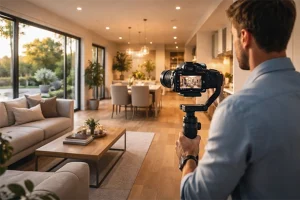
Video walkthroughs provide guided visual narratives through a property. They work well for residential and small commercial assets where layout and flow drive interest.
3D Property Tours
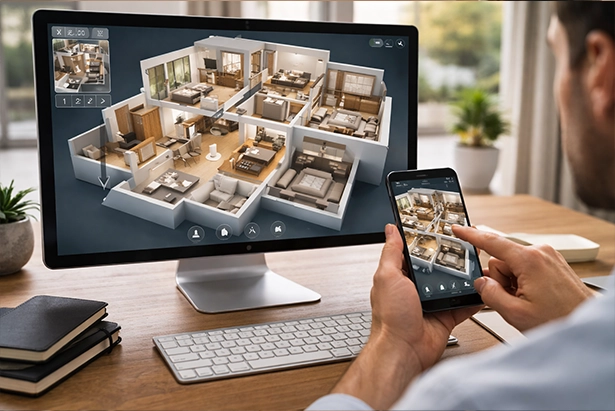
3D Real estate video tours allow users to explore spaces interactively. These formats enable remote buyers and international investors understand complex floor plans and multi-level layouts.
Drone Real Estate Videography
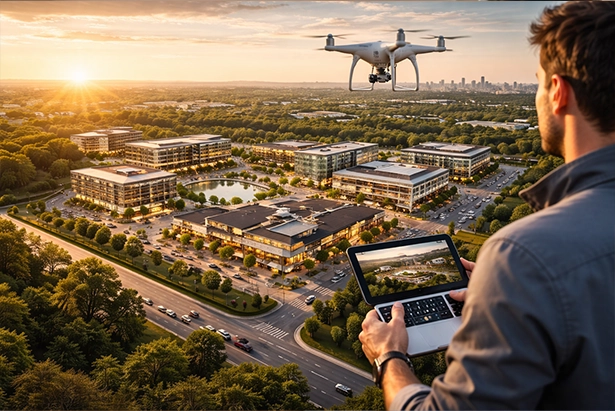
Drone footage establishes context. It shows access, surroundings, and scale. This is critical for commercial real estate video tour content, land parcels, and large developments. Each format supports a different stage of buyer evaluation and sales decision-making. Choosing between them is a strategic decision, not a creative one.
Why Video-Based Listings Generate Stronger Buyer Intent?
The psychology behind video real estate tours explains their effectiveness.
Video reduces cognitive load and shortens the buyer’s evaluation cycle. It replaces imagination with clarity. Buyers spend less energy interpreting images and more time assessing fit. This leads to stronger intent signals that reduce unqualified inquiries and increase high-quality sales leads. At this stage, marketing leaders begin asking how to use video tours to generate real estate leads without increasing acquisition costs or compromising listing accuracy.
This is also why many homeowners prefer agents who use video marketing. Video signals seriousness, transparency, and market alignment without requiring verbal persuasion.
Operational Challenges in Scaling Video Tours for Property Sales
Despite clear demand, many organizations struggle to scale real estate video marketing. Common constraints include:
- Inconsistent visual quality across listings
- Delays between property readiness and content availability
- High internal coordination costs
- Difficulty maintaining brand consistency across regions
These issues persist because video production often lacks standardized workflows aligned with sales and marketing goals. Without clear operating models, teams revert to photos or ad hoc video usage. Internal teams often debate how to make real estate video tours consistent across markets while maintaining speed and compliance standards.
This gap fuels interest in topics like outsourced real estate video editing and white label real estate video editing, not as solutions, but as structural responses to internal capacity limits.
Storytelling as a Conversion Differentiator in Property Marketing
Beyond clarity, video enables narrative. Storytelling with cinematic property videos allows agencies and developers to frame space with purpose.
Narrative does not mean dramatization. It is structural visual guidance for buyer understanding, showing transitions, establishing context, and reinforcing positioning.
This is where the importance of stable and cinematic real estate tours becomes evident. Stability communicates professionalism. Cinematic pacing supports comprehension, and poorly executed video harms credibility and weakens buyer trust.
How Organizations Evaluate Video Tour Strategies for ROI
Decision-makers compare strategies based on scalability and business impact rather than individual providers. Some rely on internal teams, while others partner with real estate video production services. These days, most decision makers explore hybrid or outsourced models for scalability.
Key evaluation criteria include:
- Turnaround predictability
- Brand consistency
- Volume handling
- Compliance with platform standards
This evaluation often leads teams to explore real estate video strategies that boost marketing ROI without locking into rigid production structures.
The Role of Technology in Scaling Video Tours Without Overpromising Results
AI-powered real estate video editing workflows receive attention due to speed and scale potential. However, buyers remain cautious.
Technology supports efficiency and turnaround speed but not buyer judgement or narrative clarity. Most organizations view AI as an enabler, not a creative decision-maker.
This balanced view shapes how organizations evaluate technology when scaling real estate video tours.
Pricing Real Estate Video Tours in Terms of Sales Value
Discussions around the price of real estate video tours often stall adoption. The issue is not cost alone, but how value is measured against sales performance.
- Video reduces wasted site visits.
- It improves buyer qualification.
- It supports remote transactions.
When evaluated against these outcomes, pricing discussions shift from expense to operational efficiency, especially for portfolio-heavy players like developers and proptech platforms.
The Bottom-Line: Real Estate Video Tours as a Global Sales Accelerator
For international investors and Real Estate Investment Trusts (REITs), video reduces geographic friction. A well-structured commercial real estate video tour supports early-stage evaluation without physical presence.
This drives interest in real estate video tour ROI at a portfolio level rather than per listing. Predictability and consistency matter more than isolated listing performance.
Within the real estate video landscape, Video Caddy operates as a scalable video editing partner aligned with broader marketing and sales workflows, rather than a standalone creative layer. Organizations engaging with providers like Video Caddy typically seek consistency, scale, and operational alignment rather than creative experimentation. This distinction matters during consideration, where trust forms through clarity, not claims.
FAQ’s
To what extent do video tours of real estate genuinely boost property sales?
Properties featuring video tours receive notably improved inquiry quality and quicker transaction processes, although outcomes differ based on asset type and location.
What distinguishes a 3D virtual tour from a video walkthrough?
A video walkthrough directs viewers sequentially, whereas a 3D virtual tour offers interactive exploration and spatial manipulation.
Is high-end, expensive camera necessary to shoot a professional-quality tour?
The quality of professional output relies more on stabilization, framing, lighting, and post-production discipline than solely on the cost of the camera.
Why do most homeowners prefer agents who use video marketing?
Video signals transparency, professionalism, and wider market reach, increasing seller confidence in representation quality.
What is the ROI of video tours for international REITs and investors?
ROI is measured through reduced travel, faster shortlisting, and improved cross-border evaluation efficiency rather than direct sales uplift.
Video Caddy